
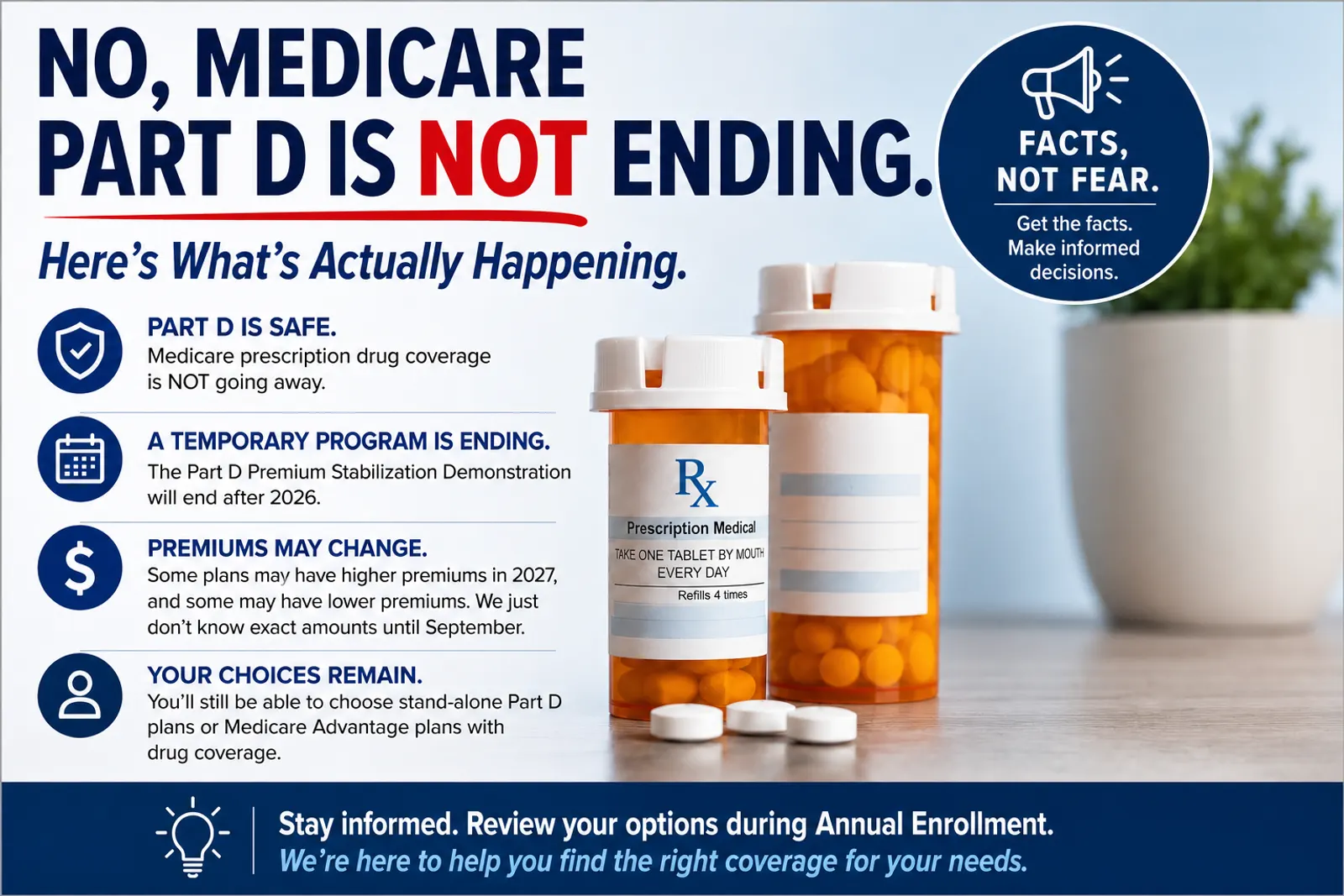
No, Medicare Part D Is Not Going Away. Here’s What’s Actually Happening.
If you’ve been watching the news lately, you’ve probably seen alarming headlines like:
“Trump is killing Medicare Part D.”
“CMS is killing Medicare drug coverage.”
“Medicare Part D is going away.”
Those headlines are eye-catching. They just don’t tell the whole story — and in the process, they’re spreading unnecessary fear among millions of Medicare beneficiaries.
Let’s separate the facts from the headlines.
Medicare Part D Is Here to Stay
Let’s be crystal clear: Medicare Part D prescription drug coverage is not ending.
Medicare beneficiaries will continue to be able to enroll in stand-alone Part D prescription drug plans, or in Medicare Advantage plans that include prescription drug coverage, beginning January 1, 2027 — just as they can today.
No one is losing their Medicare prescription drug benefit.
So why the confusion?
What Is Really Ending?
The Centers for Medicare & Medicaid Services (CMS) recently announced that it will end the Part D Premium Stabilization Demonstration after the 2026 plan year.
That sounds technical, and that’s because it is.
This demonstration program was never Medicare Part D itself. It was a short-term government program designed to prevent premiums for stand-alone Part D plans from rising too quickly while major changes from the Inflation Reduction Act were being phased in.
Think of it this way: imagine your electricity bill suddenly going up because energy prices changed. The government offers a temporary credit to soften the increase. When that credit eventually runs out, your electricity doesn’t disappear — only the subsidy does.
That’s exactly what’s happening here. What’s going away is the temporary financial support, not Medicare Part D.
Why Was the Program Created in the First Place?
The Inflation Reduction Act made major changes to Medicare Part D, including a cap on how much beneficiaries can pay out of pocket for prescription drugs each year.
Those changes shifted more financial responsibility onto the insurers that offer stand-alone Part D plans. To help the market adjust, CMS created a temporary stabilization program in 2025 to prevent steep premium increases while insurers got used to the new rules.
The demonstration did its job: it helped the market adjust and kept premiums from swinging too wildly.
Now, CMS believes insurers have enough experience operating under the redesigned benefit to price their plans accurately without further federal assistance.
What This Could Mean for You
Here’s where the story actually matters.
Without the temporary stabilization program, some stand-alone Part D plans may have higher premiums in 2027 than they otherwise would have.
Notice the word “may.” Nobody knows exactly which plans will go up, or by how much, just yet. CMS won’t release final 2027 premiums until September, since each insurance company sets its own rates.
CMS estimates that most beneficiaries will see premium increases of less than $10 a month, though the actual change will depend on your specific plan and where you live.
That’s a long way from “Medicare Part D is over.”
Should You Be Concerned?
Not necessarily — but you should pay attention.
Every year during the Annual Enrollment Period (October 15 through December 7), Medicare beneficiaries should review their prescription drug coverage anyway. Here’s why:
- Drug formularies change from year to year.
- Premiums vary by plan and location.
- Pharmacy networks evolve.
- Your own medications and health needs can change too.
This year simply underscores why that annual review matters.
For some people, their current plan will still be the best option. Others may be able to save hundreds of dollars by switching Part D plans. And for some, a Medicare Advantage plan with built-in prescription drug coverage may be worth a look — but only if it includes your doctors, hospitals, and prescriptions. Premium price should never be the only factor in that decision.
Beware of Sensational Headlines
Unfortunately, health care news tends to reward dramatic headlines over accurate explanations.
“Temporary Premium Stabilization Program Expires” doesn’t get nearly as many clicks as “Medicare Part D Is Ending.” But one of those headlines is deceptive, and the other is simply the fact.
When you see an alarming Medicare headline, take a breath before jumping to the worst conclusion. Most of these stories are missing the context that beneficiaries actually need.
The Bottom Line
Here’s what to keep in mind:
- Medicare Part D is not going away.
- Your prescription drug coverage is not going away.
- A temporary program that helped keep premiums down is ending after 2026.
- Final 2027 rates won’t be known until September, and some stand-alone Part D plans may cost more next year.
- With the Annual Enrollment Period almost here, it’s more important than ever to compare plans and look for savings.
At Medicare Experts, we believe decisions about your Medicare coverage should be based on facts, not fear.
If you have questions about how these changes might affect your coverage, don’t rely on sensational headlines for answers. Talk to a licensed Medicare professional who can look at your specific situation and walk you through your options.
And that’s exactly what we’re here for.
We don’t work for insurance companies. We work for you.
Have questions about your Part D coverage? We’re here to help.
Talk to a Medicare Expert