
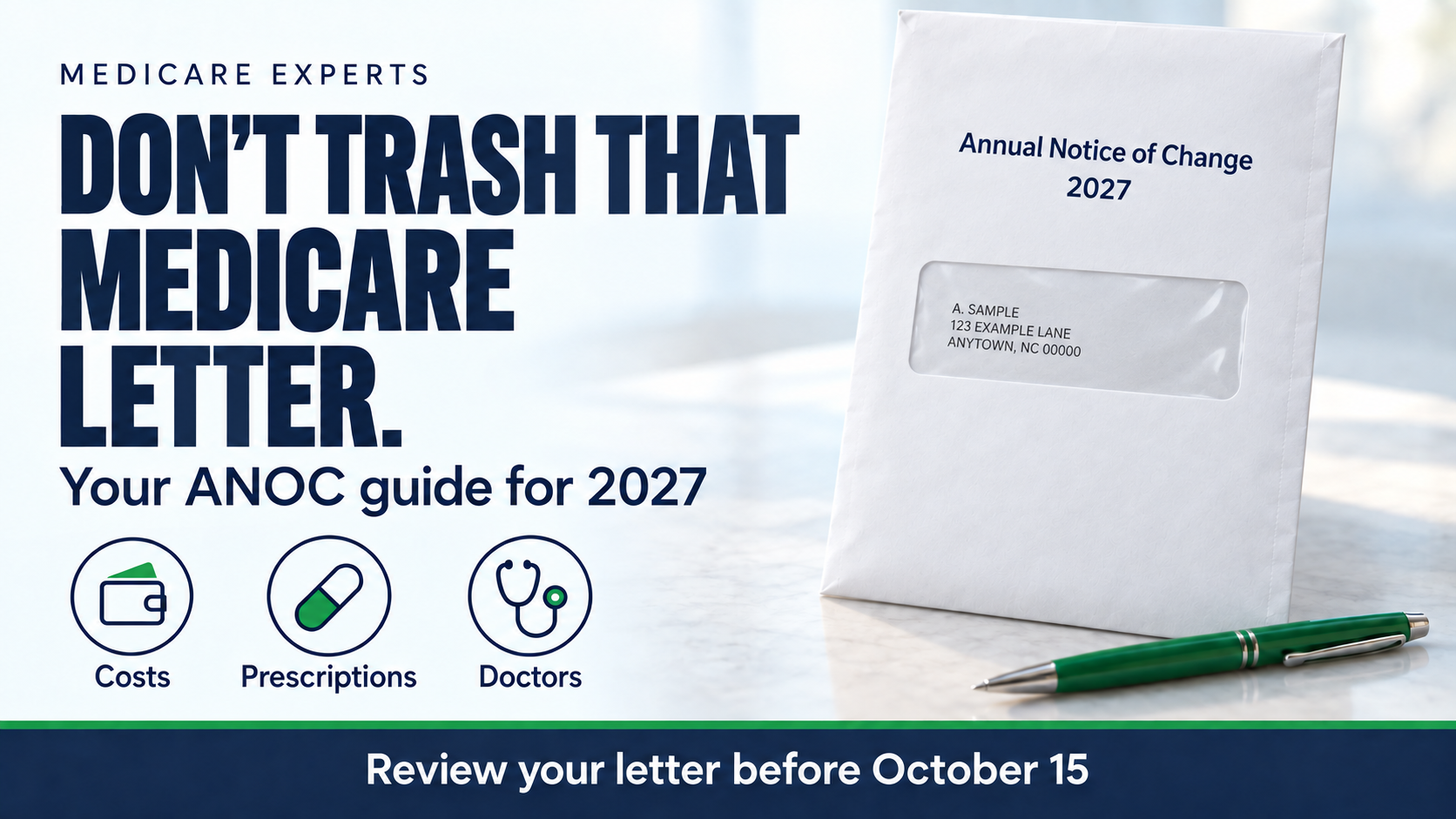
Every fall, a thick envelope shows up in the mailbox with Medicare written all over it. For a lot of people in North Carolina and across the Southeast, the first instinct is the same: set it aside with the other junk, or toss it.
Please don’t.
That letter is often your Annual Notice of Change—your ANOC—and it’s one of the most important pieces of mail you’ll get before Medicare’s fall enrollment window. It’s not a bill. It’s not a scam mailing (though scams do exist, so verify the sender). It’s your plan’s heads-up about what will change next year if you stay put.
This guide walks through what an ANOC is, what to check, and what to do before October 15, when Medicare’s Annual Enrollment Period (AEP) opens for 2027 coverage.
First, a quick word on timing
Medicare’s Annual Enrollment Period (AEP) runs October 15 through December 7.
If you make a change during AEP, it usually takes effect January 1, 2027. If you do nothing, many people are automatically renewed into the same plan for the next year—with whatever updates the plan announced in the ANOC.
That’s why the letter matters. Auto-renew is convenient. It’s also how people wake up in January paying more, facing a different drug list, or discovering a doctor is no longer in network.
This article is educational and not personalized Medicare advice. Your Medicare Experts / Medicare Experts is an independent licensed brokerage and is not affiliated with the federal Medicare program.
What is an ANOC, in plain English?
ANOC stands for Annual Notice of Change.
Think of it as your plan’s “Here’s what will be different next year” report. Plans send these notices before AEP so you can compare the upcoming year to the year you’re in now.
You might also get related plan materials around the same time (for example, an Evidence of Coverage or other plan documents). The name on the envelope can vary, but the job is the same: tell you what is changing so you can decide whether to stay, switch Medicare Advantage plans, change Part D drug coverage, or look at other options that fit your situation.
If you’re not sure whether what you received is an ANOC, look for language about changes for the coming year, premiums, benefits, formulary/drug list, or provider network. When in doubt, keep the packet and review it with a licensed Medicare advisor.
Myth-busting: “If I liked my plan this year, I’m fine.”
Maybe. Maybe not.
Plans can change year to year even when the plan name looks the same. Common shifts include:
- Monthly premium (up or down)
- Deductibles and copays
- Which drugs are covered and at what tier
- Preferred pharmacies
- Which doctors, specialists, and hospitals are in network
- Extra benefits (dental, vision, hearing, OTC allowances, and similar extras)
None of that means your plan is “bad.” It means last year’s fit isn’t automatically next year’s fit. The ANOC is how you find out before January.
What to check in your ANOC (and related plan materials)
Set aside 20–30 quiet minutes. A highlighter helps. You’re looking for anything that would change your cost, your medications, or your access to care.
1. Premiums and your share of costs
Check:
- Monthly plan premium
- Part B give-back / premium reduction (if your Advantage plan offers one)—and whether that amount is changing
- Deductibles
- Copays and coinsurance for primary care, specialists, ER, urgent care, inpatient stays, and labs
Ask yourself: If these numbers are my reality on January 1, does my budget still work?
2. Your prescription drugs
Drug coverage is where many people get surprised.
Look for:
- Whether each of your medications is still covered
- Tier changes (a drug moving to a higher tier usually means you pay more)
- Prior authorization, step therapy, or quantity limits
- Preferred vs non-preferred pharmacy rules
- Mail-order options and pricing
Pull your current medication list—name, dose, how often you take it—and check each one against next year’s formulary information in the packet (or on the plan’s materials / Medicare Plan Finder tools on medicare.gov).
If even one critical medication changes status, that’s worth a full plan review.
3. Doctors, specialists, and hospitals
Network changes are easy to miss until you need an appointment.
Confirm:
- Your primary care doctor
- Specialists you see regularly
- Hospitals and facilities you prefer
- Whether referrals or prior auth rules are changing
If you or a spouse are managing ongoing conditions, this section deserves extra attention.
4. Pharmacy and how you fill prescriptions
Even when the drug is covered, where you fill it can change your cost.
Check preferred pharmacies, retail vs mail-order differences, and whether your usual pharmacy is still preferred for 2027.
5. Extra benefits you actually use
Dental cleanings, vision exams, hearing aids, fitness, transportation, OTC cards—these can change too. Keep what you use; don’t overvalue extras you never touch.
What to do before October 15
You don’t have to change plans. You do want a clear picture before AEP starts.
A simple checklist:
- Keep the ANOC packet. Don’t shred it until you’ve reviewed it (or had help reviewing it).
- Make a one-page snapshot of your needs: doctors, drugs, pharmacies, and must-have benefits.
- Compare “stay vs switch” using medicare.gov tools and plan materials—or sit down with a licensed Medicare advisor who can walk through options for your ZIP code and prescriptions.
- Mark your calendar: AEP is October 15–December 7. Changes made in that window typically begin January 1, 2027.
- Beware of pressure tactics. Educational help is good. Fear-based “you must call today or lose Medicare” pitches are a red flag.
If your ANOC looks identical to last year and your doctors and drugs are unchanged, staying may be perfectly reasonable. The point is to decide on purpose, not by default.
Bottom line
Your ANOC isn’t junk mail. It’s your early warning system before Medicare’s fall enrollment window.
- AEP: October 15–December 7
- Typical effective date for AEP changes: January 1, 2027
- Auto-renew is common—which is fine only if next year’s plan still fits your premiums, drugs, doctors, and pharmacy
If you’d like a calm, second set of eyes on your ANOC and your medication list, Your Medicare Experts (Medicare Experts) is here to help you understand your options. We’re independent licensed Medicare advisors serving North Carolina and the Southeast. We’ll explain what’s changing in plain English—no scare tactics.
Educational content only. Not personalized advice. Not affiliated with the U.S. government or the federal Medicare program. Plan availability and benefits vary by location and may change.
About Your Medicare Experts
Independent licensed Medicare brokerage helping seniors and caregivers compare Medicare Advantage, Part D, and related options with clear, education-first guidance.